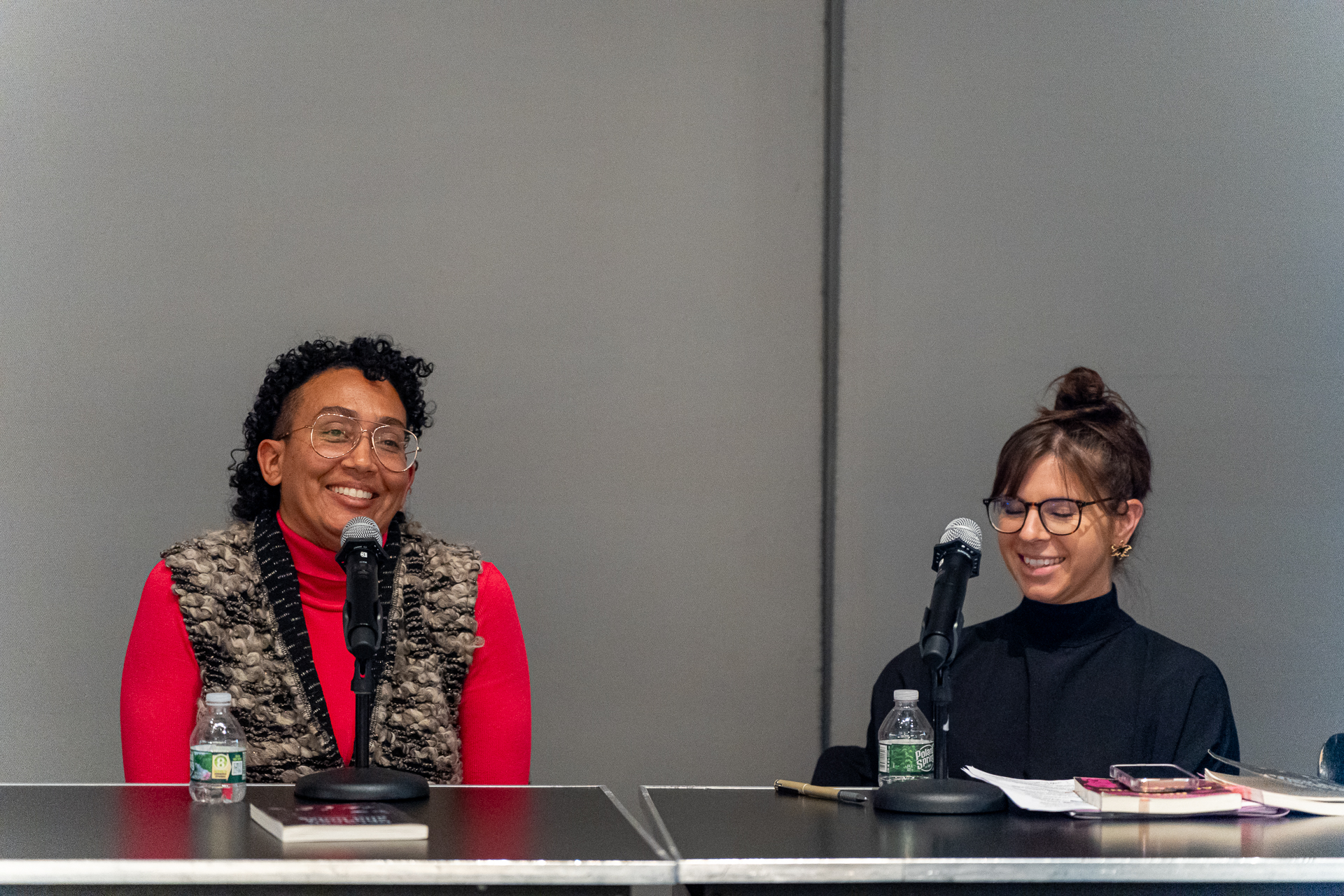
Dr. Amber J Musser and Dr. Danica Savonick discuss their research processes and their new works, ‘Between Shadows and Noise’ and ‘Open Admissions’ at the November 4th, University Worth Fighting For event, ‘The Future of Research’.
The energy in the room was palpable on Monday, November 4th, 2024 as students and faculty entered the Skylight Room at the Graduate Center to hear from two esteemed colleagues, Dr. Amber J Musser and Dr. Danica Savonick on how they turned their inspiration into two critically acclaimed works of scholarship. This intimate and casual panel was facilitated by FI Graduate Fellows, Jasmeene Francois and Will Arguelles, who guided the audience through the speakers’ presentations and fielded questions.
The night began with a ‘Think, Pair, Share’ activity led by Jasmeene Francois, who asked “What are your research methods? What kinds of research methods would you like to try either within your discipline or not?”. The audience paired off and discussed, sharing their own experiences and expressing interest in the research methods of others. Jasmeene then introduced Dr. Amber J. Musser, Professor of English and Africana Studies at the Graduate Center, whose work examines the intersection of race, sexuality and aesthetics in art and culture, and whose most recent book, Between Shadows and Noise: Sensation, Situatedness, and the Undisciplined was praised as work that “will reshape current conversations in Black studies, feminist studies, art criticism, performance studies, film studies and beyond” by Professor Omise’eke Natasha Tinsley.
Dr. Musser began by reading a passage from her work, contemplating the history, aesthetics, and feelings evoked by her interaction with a piece of sculptural artwork entitled “A Pillow for Fragile Fictions” by artist Titus Kaphar.

A Pillow for Fragile Fictions, Titus Kaphar, 2016
The sculpture, a blown glass representation of George Washington’s Bust, is filled with rum, lime, molasses, and tamarind. It sent Dr. Musser on a journey exploring the potential meaning behind this representation- particularly in its use of tamarind, a seldom considered fruit in the context of colonialism and the trans-atlantic slave trade. Musser’s passage wove together historical prose, folk knowledge, storytelling, and personal experience to explain the beautiful history of tamarind as a vehicle for resistance and community building in these enslaved communities.
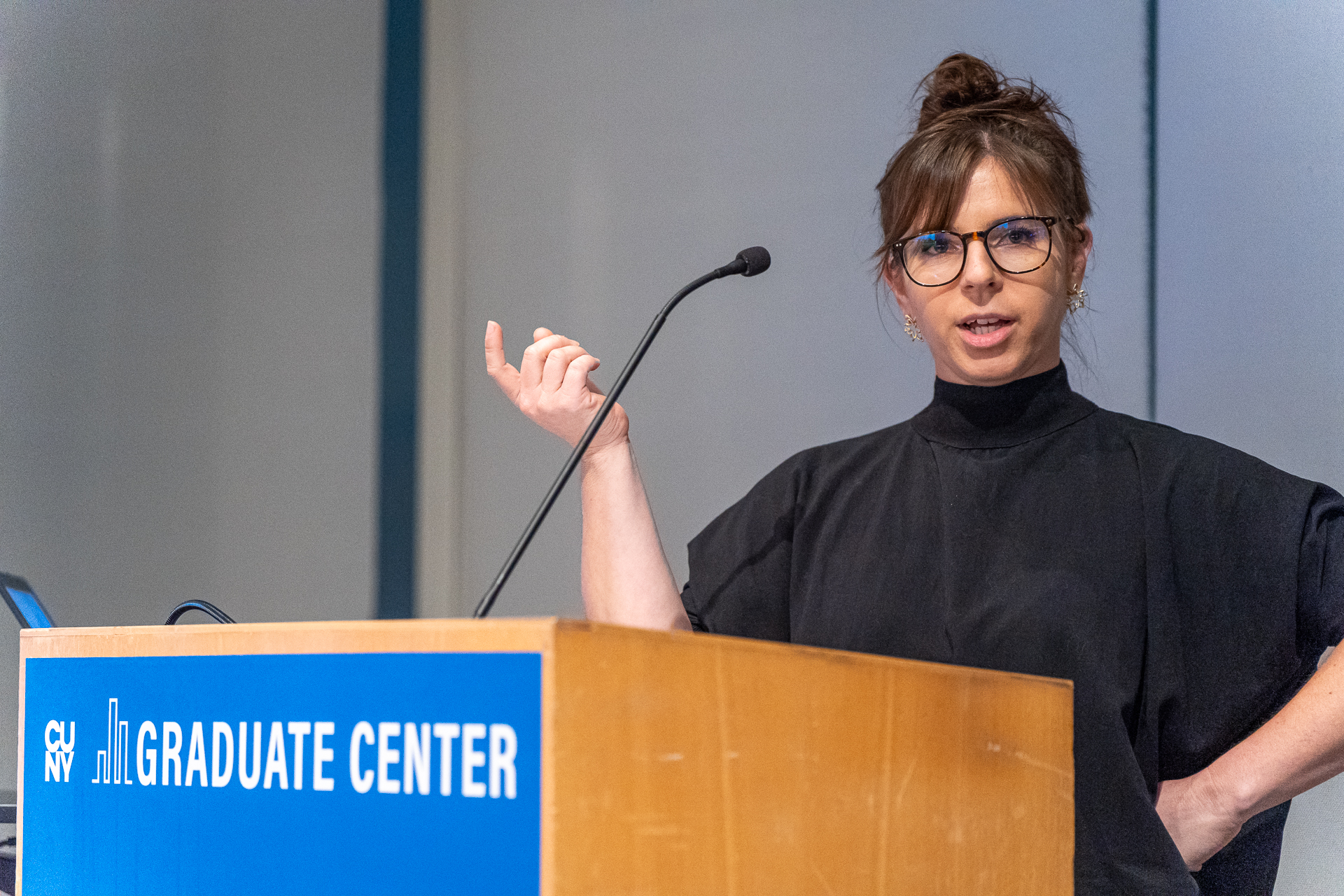
Dr. Danica Savonick explains her research process.
Jasmeene Francois then introduced Dr. Danica Savonick, who is currently an Assistant Professor of English at SUNY Cortland, and was also the first FI Graduate Fellow 10 years ago! Dr. Savonick’s newly published work Open Admissions: The Poetics of and Pedagogy of Toni Cade Bambara, June Jordan, Audre Lorde, and Adrienne Rich in the Era of Free College, has been lauded as a model to “reactivate Toni Cade Bambara, June Jordan, Audre Lorde, and Adrienne Rich” by poet and Lorde biographer Alexis Pauline Gumbs. Savonick used historical syllabi and literature produced concurrently by these great authors and educators to explore how the real-life socio-historical context of teaching in the CUNY system not only affected their pedagogical practices, but their writing as well.
Dr. Savonick’s recited passages provided valuable insight into her research methods, emphasizing how she wanted her own writing to be widely accessible, understandable, and free of dense theoretical language. She frames the book narratively so that it reads like creative non-fiction, keeping the readers engaged while making them feel as if they’re in the classrooms she’s describing. One story Savonick highlighted was about Dr. Toni Cade Bambara, professor of English at City College during the anti-war demonstrations of the 1960’s. Noticing that her students were more engaged with social activism than with the course material, Bambara made the radical decision to ‘hand the course over’ to her students, allowing them to decide what they’d learn, how they’d learn it, and on what terms they’d participate in their course.
After sharing an extremely useful flow chart explaining her research process, Dr. Savonick turned the discussion back to Jasmeene Francois, who opened the discussion up to questions from co-facilitator, Will Arguelles.
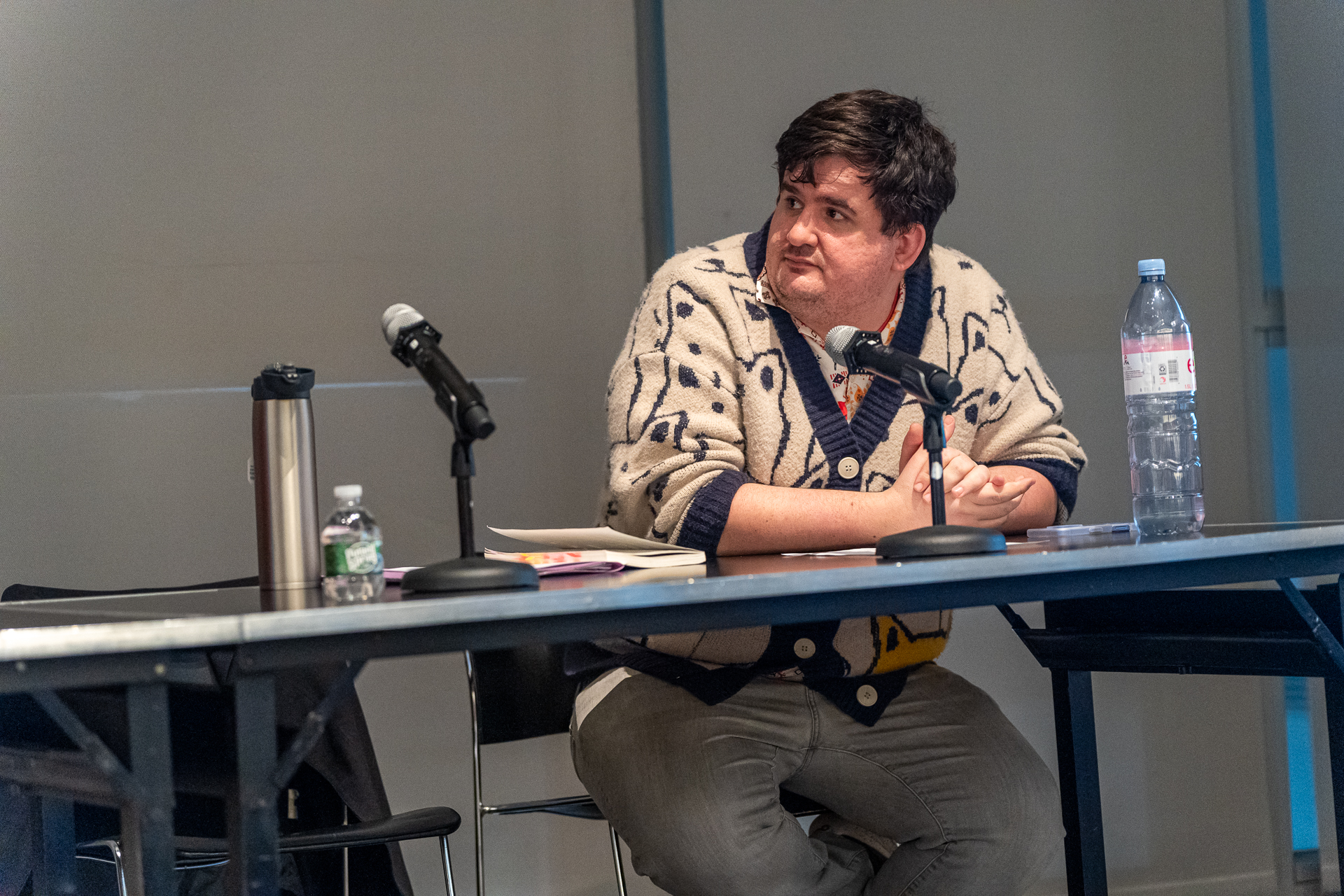
FI Graduate Fellow Will Arguelles engaging with panelists at the November 4th UWFF event.
Arguelles asked: “Both of you [Musser and Savonick] talked about building a story and narrative out of things you experienced or came across in your daily lives. How did you decide what you were going to research and why? For example, Dr. Musser, why tamarind and not another spice? And Dr. Savonick, why course assignments and syllabi?”
Dr. Musser mused about the ‘stickiness’ of the details which drew her attention. The incorporation of tamarind into the art piece was so fascinating, she often wondered “why can’t I stop thinking about it? Is there a body system that this is attached to?” This deep fascination and interest stuck with her for a long time and eventually blossomed into a ‘fruitful’ (pun intended) line of inquiry and research. Dr. Savonick had a similar method for choosing a research topic. She asked herself “What sticks with me? What do I keep returning to?” and allowed those answers to guide her to her research topic. After a bit more discussion about ‘stickiness’, research and organizational methods, and balancing teaching and research, the moderators turned to the audience for questions.
One audience member prodded Dr. Musser to unpack a previous comment she had made about her intended book audience being different from her audience for her dissertation. “Do you keep [future publications] in mind while you write your dissertation, knowing that the audience will change? Where do you think those two audiences might converge?”
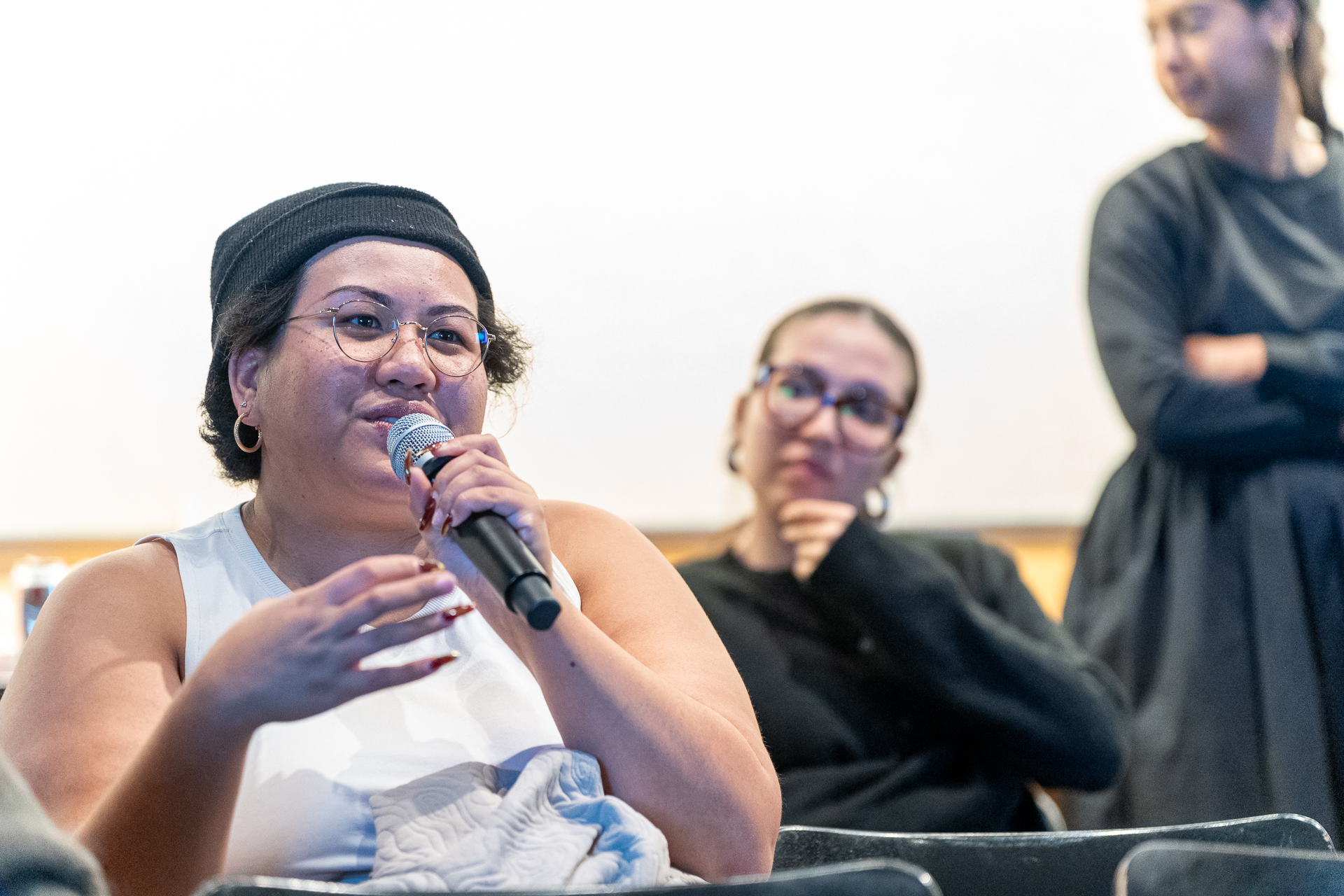
An audience member asks panelists about their writing process.
Dr. Musser explained that ‘your dissertation proves your mastery of the topic, and shows that you know how to produce an argument and provide evidence for that argument. Ideally your committee enjoys it, but it’s not necessary. Part of it is your command of the information and the argument, but most of the advice from [future book] editors will be to take out a lot of the footnotes, the in-text citations, etc. [from your dissertation]. It’s a lot of streamlining to focus on what the story is [for a publication] versus what the dissertation is.. Books read better when they’re more porous — when it’s about you and your argument, especially when it’s your first book.’
Dr. Savonick added, “your dissertation committee is paid to read your dissertation versus when you write a book, you have to make people want to read it. You have to set up a story and get readers interested and invested in it.”
Another audience member then asked about the process of reverse outlining. ‘What’s your relationship with [reverse outlining] and how did it help you get to the end of your book?’
Dr. Savonick motioned towards the screen, which showed the reverse outlining process she used while writing Open Admissions. ‘It just comes from my experience as a writing teacher,’ she explained, ‘Reverse outlining is a way of reading what’s been written and figuring out, okay, what is the main point of this entire section?’ She then went on to explain how she would organize her evidence to support her main ideas and how that would help her figure out what she was trying to say.
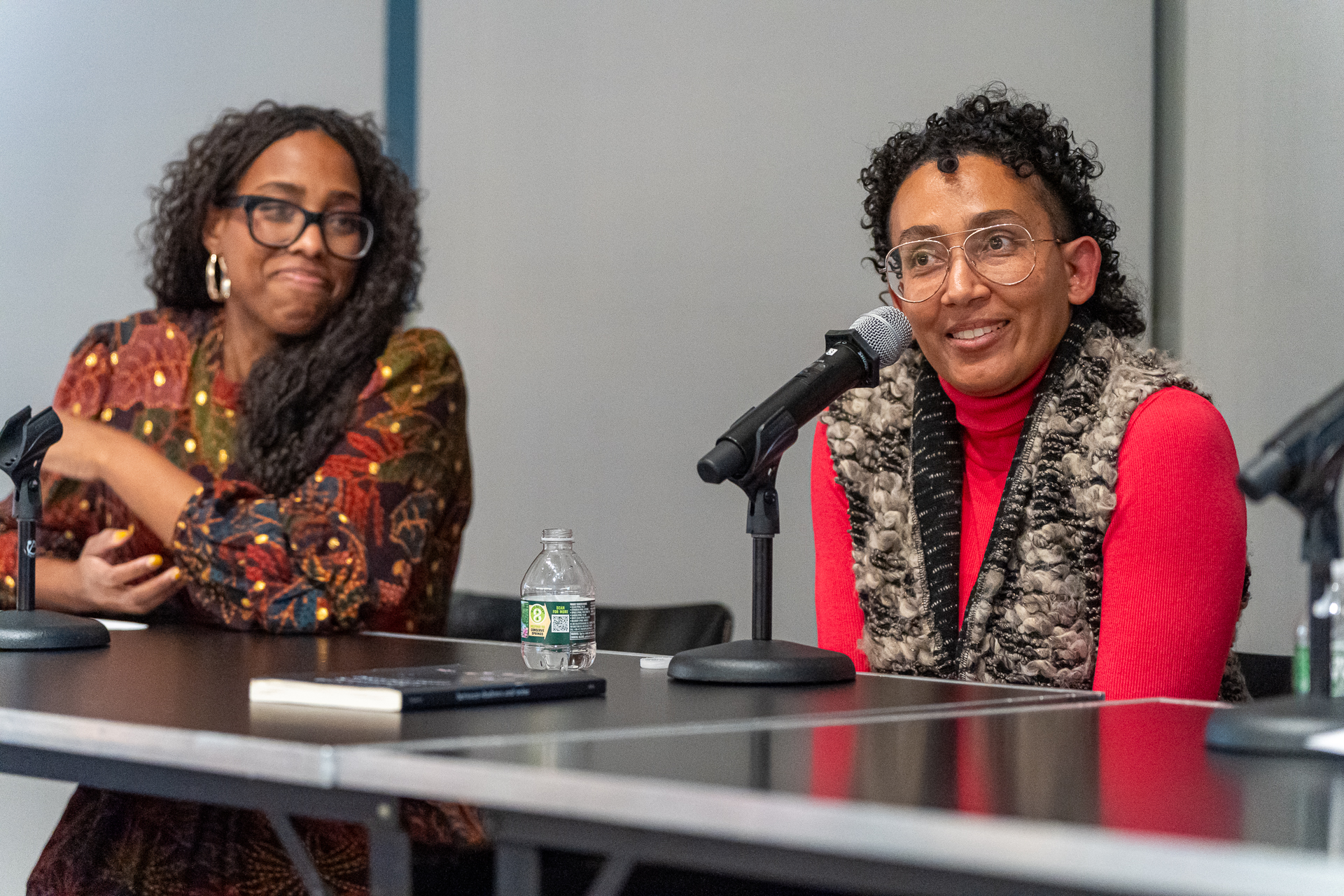
Jasmeene Francois (L) and Dr. Amber J Musser (R) field questions about the research and writing process.
Dr. Musser added that because she starts with a free writing process, she uses reverse outlining as a way to take a step back and ask herself questions like ‘what is happening here? How can I rearrange this? Where are there gaps in the narrative?’ It helps her pull the narrative line together after she free writes, providing her with an opportunity to see what her evidence is doing in relation to what she thought or hoped it would do.
The last audience question touched on an extremely relevant and important issue: that of incorporating new media into our storytelling. ‘As fewer students these days are actually reading books and are learning through different forms of media, like podcasts, do you have thoughts about any new methods or outputs that you’re interested in using when you think about the future of your own research?’
Dr. Savonick explained that while she was still excited and hopeful for her students to continue actually reading physical books, she would be interested in expanding her work into the realm of digital humanities. She excitedly explained that she would love to be able to create an interactive timeline to complement her book where one could scroll through and see how each author’s teaching corresponded with their writing and the sociopolitical issues of the day.
Dr. Musser stressed the idea of having students actually sit and talk to one another. She suggested that people may enjoy listening to podcasts because of their conversational nature and that facilitating conversation would be key to having students engage in critical questioning.
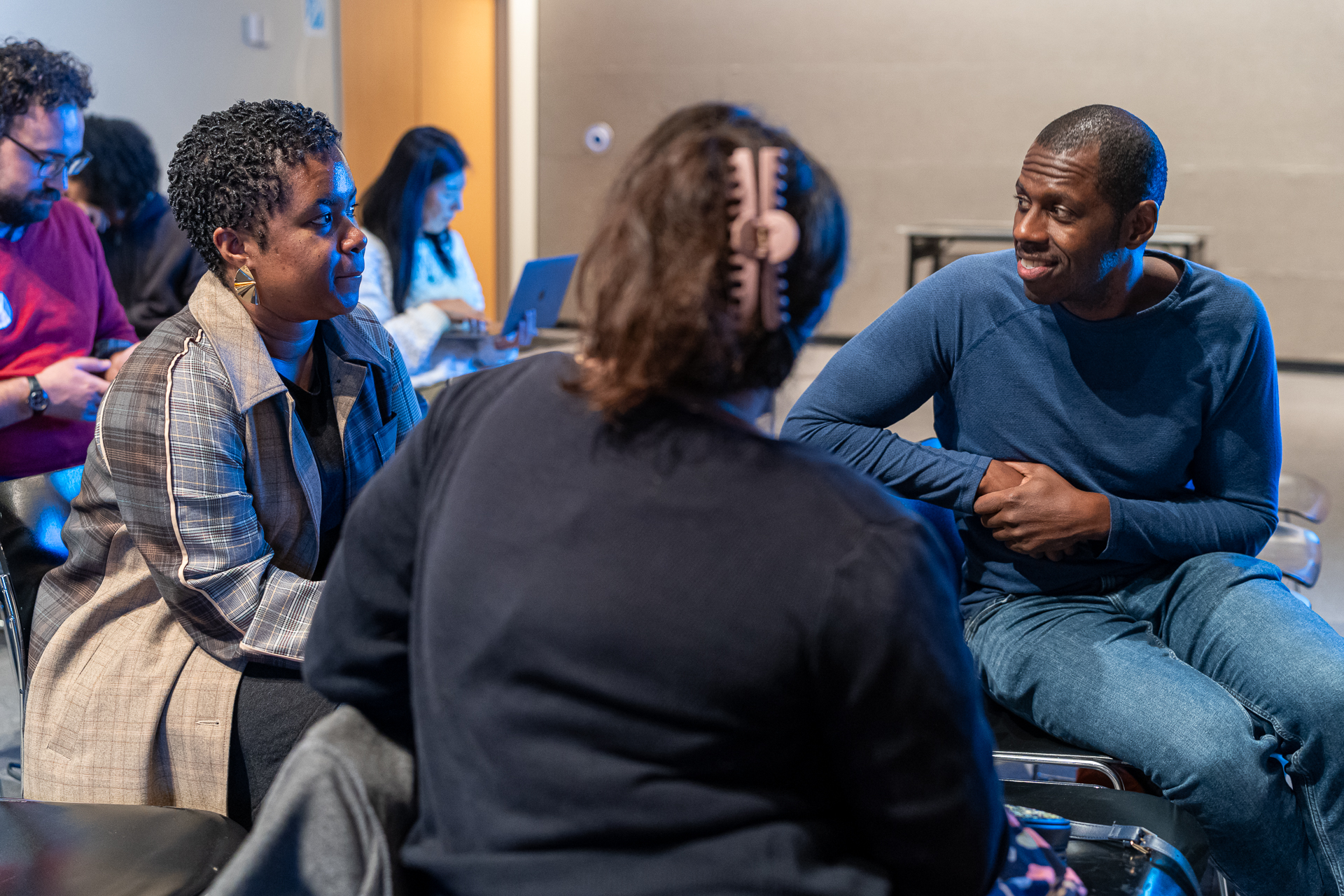
Panel participants mingle and discuss their research strategies.
After a few more questions and comments from the audience, Jasmeene and Will thanked the presenters for their time and opened the room up for conversation with snacks and drinks. The audience then spent the rest of the evening mingling with each other and with the panelists, smiling, laughing and engaging in deep conversation. A hopeful, spirited reprieve from the chaos and uncertainty of the outside world. ✨
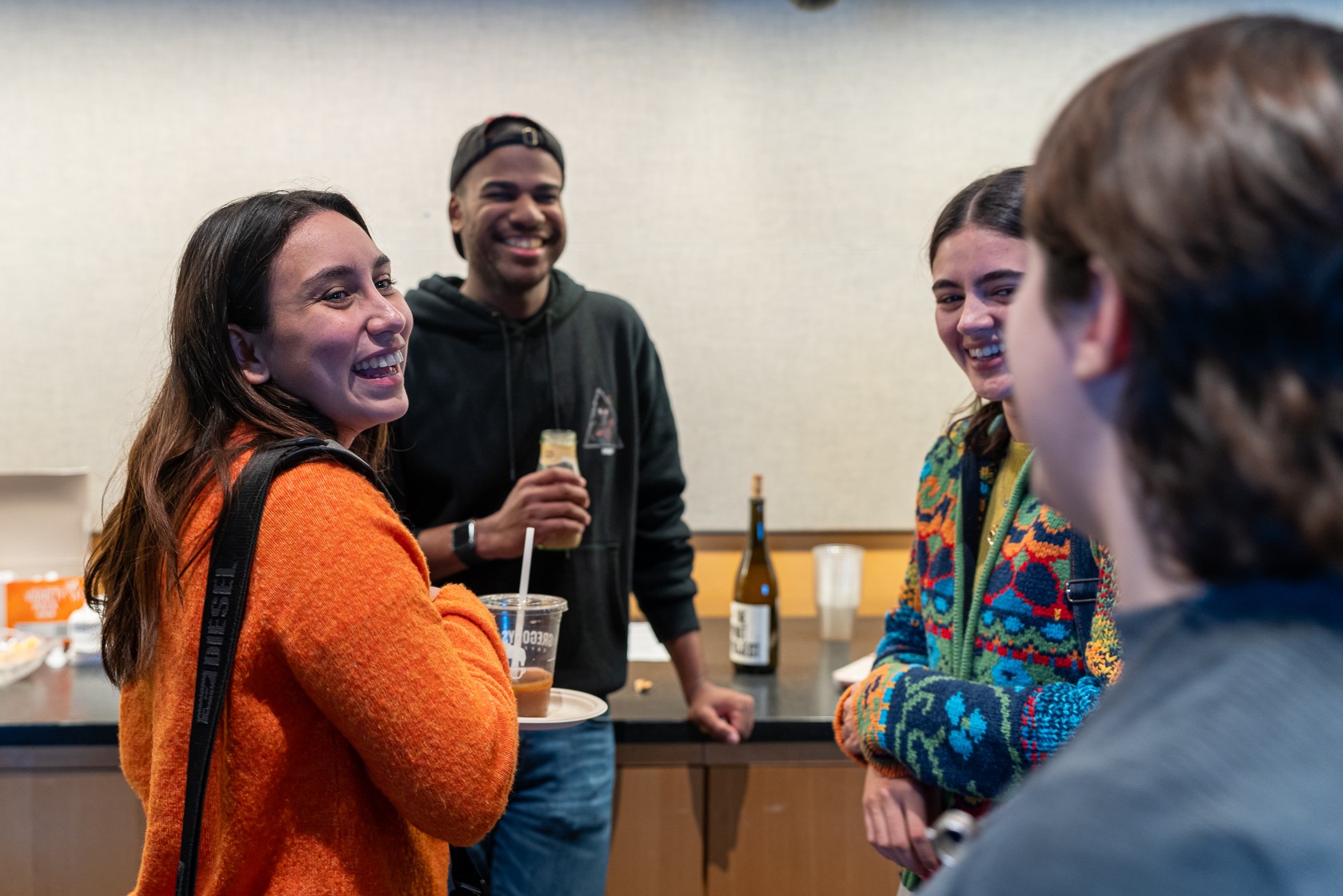
Participants share some laughs over snacks and beverages as the event winds down.