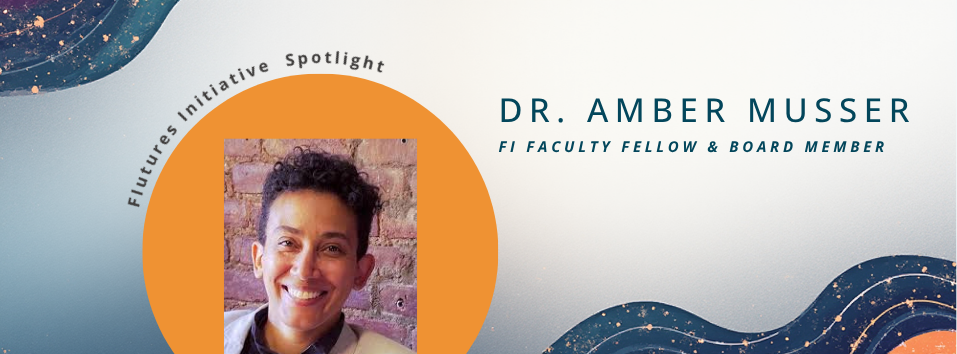
Dr. Amber Jamilla Musser is a 2025 Futures Initiative Faculty Fellow and a Future’s Initiative Board Member. A professor of English, Africana Studies, and Black, Race, and Ethnic Studies (BRES) at the CUNY Graduate Center, Dr. Musser has published widely on race and critical theory, queer femininities and race, race and sexuality, and queer of color critique. She has an MSt in Women’s Studies from Oxford University and received her PhD in History of Science from Harvard University. She has held fellowships at New York University’s Draper Program in Gender Studies and Brown University’s Pembroke Center for Teaching and Research on Women. Her research has been supported by grants from the Ruth Landes Memorial Fellowship and the Arts Writers’ Grant from the Warhol Foundation. She previously taught at New York University Washington University in St. Louis, and George Washington University.
She is the author of Sensational Flesh: Race, Power, and Masochism (NYU Press, 2014), Sensual Excess: Queer Femininity and Brown Jouissance (NYU Press, 2018), and Between Shadows and Noise: Sensation, Situatedness, and the Undisciplined (Duke University Press, 2024). Her collaborative projects include co-editing Keywords for Gender and Sexuality Studies (NYU Press, 2021) and co-hosting its accompanying podcast Feminist Keywords; special issues of Signs: A Journal of Feminist Theory on “Care and Its Complexities” and ASAP Journal on “Queer Form;” and the series Elements in Feminism and Critical Theory for Cambridge University Press. She was President of ASAP (Association for the Study of the Arts of the Present) from 2022-2023 and co-chaired ASAP-14: Arts of Fugitivity in Seattle in 2023 and ASAP-15: Not a Luxury in New York City in 2024. She is also co-Editor of Social Text.
FI is very excited to announce that Dr. Musser will also be co-teaching a Team-Taught Course: Places, Pleasures, and Queer Intimacies alongside Dr. Matt Brim, Executive Director of CLAGS: The Center for LGBTQ Studies at the CUNY Graduate Center and Professor of Queer Studies in the English department at the College of Staten Island.
The Fall 2025 course looks at various histories of queer nightlife, to center the different ways that queer people have built solidarities, community, and friendship in bars, raves, and other places to gather. The course will consider what kinds of intimacies with strangers are possible outside the home, what broader relationships nightlife can elaborate and sustain, and what kind of publics queer people have produced across the long twentieth century. We will think through questions of surveillance, gentrification, activism, and access as we look across these different spaces. Readings will include: Stone Butch Blues, raving, The Bars Are Ours, Time Square Red, Times Square Blue, Zami, The Terminal Bar, and Mother Camp.
Can you tell us a bit about your experience teaching an FI team-taught course and about the collaborative teaching process?
It’s been a really intellectually invigorating team teaching with Matt. We initially agreed on the broad theme for the course and then had several conversations to figure out how to trim our interest in queer intimacies and geographies into a semester-long course. We decided that students were likely to come into this course with their own set of interests in queer nightlife, which meant that we wanted to give everyone space during the final weeks of the course to do a presentation and that we wanted the course material itself to present different methods of approaching queer nightlife. We decided that we wanted to have a set of assignments that focused on 1) description 2) analysis of outside forces on queer nightlife 3) the sensual aspects of going out. It’s been really wonderful to delve into these texts with the focus on how these thinkers are getting into questions of intimacy and place, what it means about how they are positioning themselves and how larger arcs of queer history show up. This approach keeps both of us slightly outside of our usual comfort zones, so we are learning as much as teaching.
What are your favorite texts in this class to teach and why?
We started the course with revisiting a classic queer studies text that I think everyone should read: Times Square Red, Times Square Blue by Samuel Delaney, which is about the old porn theaters in Times Square pre-gentrification. Delaney uses the first half of the book to do an autoethnography and then he theorizes about the importance of contact with strangers. It’s a really wonderful time capsule and gives lots of ways to think about different forms of intimacies in addition to offering methodological provocations.
What projects are next for you? Are you working on anything that will be related to Places, Pleasures, and Queer Intimacies?
I’ve been working on a project about Black female artists sculpting figures of the sphinx— Kara Walker, Lauren Halsey, and Simone Leigh– to think about questions of Black feminism and materiality, mythology, and racial capitalism. However, I’m also in the early stages of thinking about a project that deals with queer intimacies in the chemical realm.