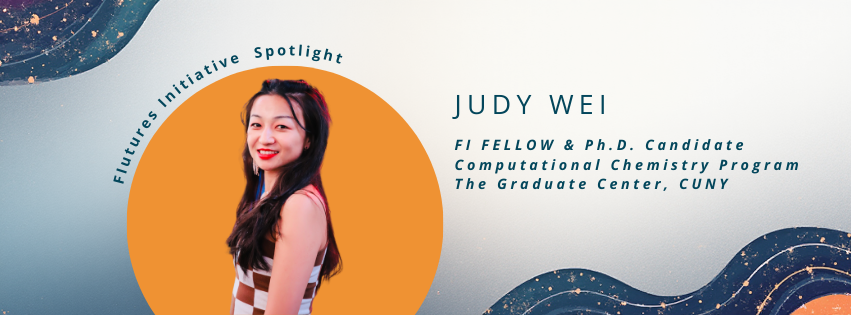
Judy Wei is a Ph.D. Candidate in the Computational Chemistry Program at The Graduate Center, CUNY.
Judy’s research focuses on understanding the photosynthesis mechanisms and inspire new approaches in renewable energy design and bioengineering. In photosynthesis, proteins convert solar energy into chemical energy. There is an essential protein (called the bacterial reaction center) that is used to change the proton gradient between the membrane, so that the generated proton gradient potential can be used for ATP synthesis.
When light is absorbed, electrons are passed on to the different pigments of the protein and eventually reduce the quinone in the bacterial reaction center. Judy’s research uses computational tools to simulate the protein motions in order to understand its mechanisms which cannot be easily captured in the experiments.
One of the fascinating mysteries of this research: the protein she is looking at contains two nearly symmetrical pathways that electrons could follow, yet almost all electrons choose only one route. Judy’s research aims to understand why this preference exists.
Even though these events have been observed by experiments, we are still not sure what determines the preference of the electron transfer pathways. To address this, Judy deliberately adds mutations to the amino acids on the electron transfer path of the protein, calculates the electrostatic potential, and tries to understand what’s happening behind the scenes. Why do the bacteria favor one side over other?
Judy aims to find out!