CONNECTING CITIES THROUGH WATER: REFLECTIONS ON AN LTER SITE EXCHANGE
By Brittany Washington
As a fourth-year PhD candidate in Earth and Environmental Sciences at the CUNY Graduate Center, I work with Professor Peter Groffman studying urban ecology and biogeochemistry, particularly how water moves through urban landscapes and influences ecosystem processes. The third chapter of my dissertation takes a multi-city approach, applying a hydrologic connectivity framework across three distinct metropolitan regions: Baltimore, Maryland; Minneapolis-St. Paul, Minnesota; and Phoenix, Arizona. The goal is to understand how the same framework can be used to investigate urban watersheds, even as the environmental conditions and factors influencing water movement differ from city to city. At the heart of my research is a question: How can hydrologic connectivity help us understand the movement, transformation, and retention of nutrients in urban watersheds, particularly when the environmental conditions shaping those processes differ from one city to another?
In August 2026, I had the opportunity to visit the Minneapolis-St. Paul Long Term Ecological Research (MSP LTER) site through the LTER Network Office’s Site Exchange Program. The program supports collaboration among researchers working in different ecosystems, and for me, it presented an invaluable opportunity to see firsthand one of the urban landscapes at the center of my dissertation research. One of the most memorable experiences was visiting the University of Minnesota’s St. Anthony Falls Laboratory, located on Hennepin Island along the Mississippi River. The facility itself is an extraordinary example of scientific infrastructure. Built directly into the river landscape, the laboratory can divert water from the Mississippi through large experimental channels before returning it to the river. These facilities allow scientists to investigate water movement, sediment transport, and the physical processes that shape rivers and watersheds.
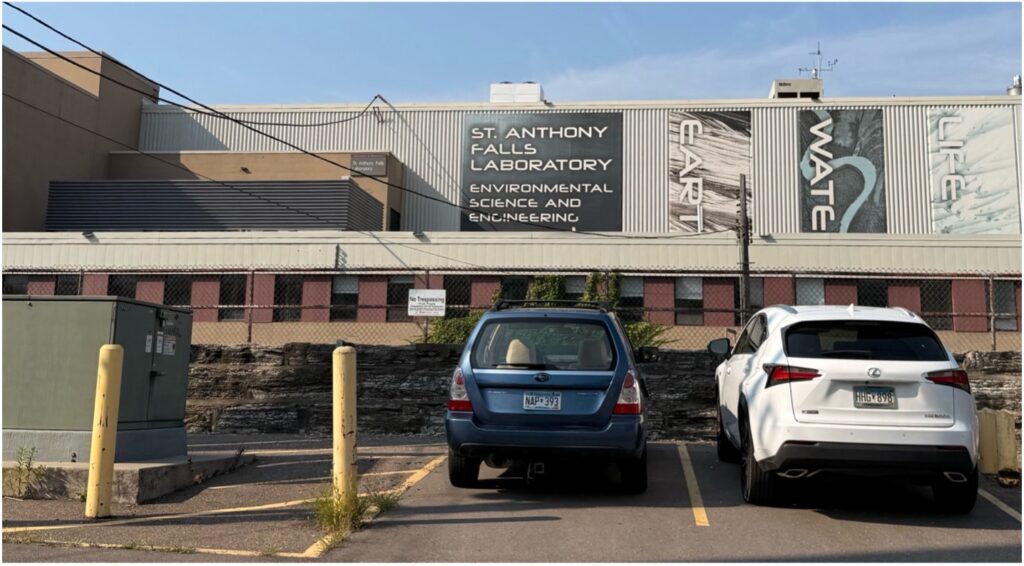
As someone studying hydrologic connectivity, I found it remarkable to stand inside a building where the river itself becomes part of the experimental apparatus. Seeing the scale of the infrastructure and the possibilities it creates for studying watershed dynamics was a highlight of the exchange. Equally valuable were the conversations and site visits organized by MSP LTER researcher Jacques Finley. Professor Finaly was so kind and warm and was willing to answer a million questions. Thank you! Through meetings with scientists and water resource professionals, I gained a deeper understanding of how the Minneapolis-St. Paul region approaches watershed research and management.
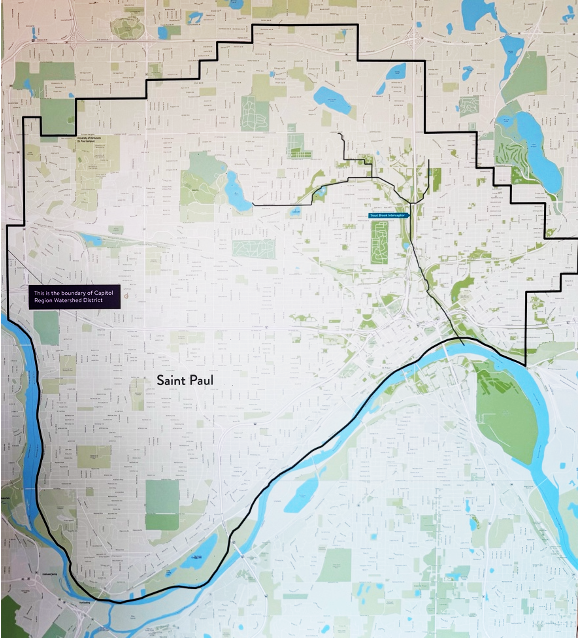
One particularly interesting distinction was Minnesota’s system of watershed districts. Unlike management systems organized primarily around municipal boundaries, these districts are established around watersheds and have responsibilities that can include water quality, flood management, and the protection of lakes, streams, and other water resources. Visiting the Capitol Region Watershed District offered a perspective on how regional governance can reflect the interconnected nature of water systems. The differences between Minneapolis-St. Paul and Baltimore were especially illuminating. The Twin Cities’ extensive lakes, groundwater systems, and water management infrastructure create a distinctive hydrologic landscape. Understanding how these features interact, and how researchers and local institutions study and manage them, encouraged me to think more critically about my own research design.
Cities across the country share many characteristics, particularly the prevalence of impervious surfaces such as roads, rooftops, and parking lots. Yet the environmental processes beneath and around that infrastructure are far from uniform. Geography, climate, geology, and the physical structure of watersheds all influence how water moves, where it is stored, and how it connects streams, groundwater, and surrounding landscapes. My experience at MSP reinforced an important consideration for my dissertation: hydrologic connectivity is not governed by the same combination of factors in every city. Understanding which processes matter most requires looking closely at the environmental context of each watershed.
I returned from Minneapolis-St. Paul with a clearer perspective on my research and renewed enthusiasm for the questions driving it. More broadly, the exchange reminded me of the value of stepping outside our own research sites and engaging directly with the people and landscapes we seek to understand. I’m grateful to the LTER Network Office and the MSP LTER researchers who made this opportunity possible. Experiences like these demonstrate why cross-site collaboration is so valuable, not only for advancing ecological research but also for expanding the ways we think about the cities and environments we study.